An advanced engineering guide comparing sway bar bushings and links. Learn how GJBUSH delivers Tier-1 NVH performance and zero-defect rubber-to-metal bonded suspension parts through automated vulcanization.
GJBUSH provides this comprehensive engineering guide to clarify the mechanical distinctions between sway bar bushings and endlinks for global automotive platforms. When evaluating chassis roll control, understanding how these elastomeric isolators manage kinetic energy transfer is critical for Noise, Vibration, and Harshness mitigation. By leveraging our forty-year rubber formula database, multiple 400T bushing vulcanizing machines, and rigorous one-million-cycle fatigue testing under SGS-certified IATF 16949 standards, we deliver Tier-1 suspension solutions. This briefing explores component functionality, degradation diagnostics, and material science to assist Supplier Quality Engineers in sourcing zero-defect anti-vibration products.
1 How Do Sway Bar Bushings and Links Affect Your Ride?
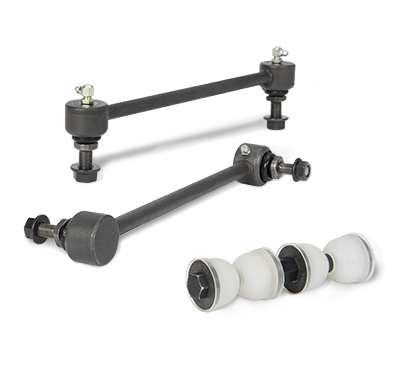
Within a modern independent suspension architecture, the sway bar, or anti-roll bar, functions as a torsional spring designed to resist vehicle body roll during cornering. This structural dynamic relies entirely on two distinct types of isolators: the sway bar bushings and the sway bar links. Sway bar bushings secure the central portion of the bar directly to the vehicle subframe, acting as the primary pivot points. Conversely, the sway bar links connect the outer ends of the bar to the control arms or strut assemblies, transferring vertical kinetic energy from the unsprung mass to the torsional spring. Because GJBUSH possesses the Tier-1-level capability to participate in joint NVH performance R&D for complete vehicles, we engineer these components to operate in perfect kinetic harmony. By custom-tuning the elastomeric hysteresis of both the bushings and the links, we ensure linear force transmission while isolating high-frequency road hash from the passenger cabin.
2 What Are the Symptoms of Bad Sway Bar Bushings and Links?
The structural degradation of chassis isolators is a progressive mechanical fatigue that severely compromises vehicle handling precision. For Supplier Quality Engineers and fleet maintenance managers, diagnosing this fatigue requires understanding the distinct acoustic signatures of each component. Worn sway bar bushings typically exhibit subsurface hollowing or bore ovalization, allowing the anti-roll bar to strike the vehicle subframe. This manifests as a heavy, hollow clunking sound when traversing speed bumps or uneven road profiles at low speeds. Worn sway bar links, which often feature small rubber-to-metal bonded nodes or micro-ball joints, produce a sharper, high-frequency rattling over washboard surfaces. GJBUSH eliminates premature elastomeric fatigue by validating all raw materials utilizing computerized rheometers and Mooney viscometers. Furthermore, we permanently resolve the risk of adhesive debonding by routing all metallic substrates through fully automatic gluing, shot blasting, and phosphating lines prior to vulcanization.
3 How Do Sway Bar Bushings vs. Endlinks Compare?
From a kinematic perspective, bushings and endlinks govern entirely different load paths and require specialized manufacturing protocols. A sway bar bushing is subjected primarily to radial compression and rotational friction. Its engineering priority is maintaining a strict dynamic-to-static stiffness ratio to prevent parasitic subframe deflection without causing excessive torsional binding. An endlink, however, must endure severe multi-axial articulation and intense vertical tension-compression cycles. To manufacture these highly stressed components, GJBUSH relies on flexible CNC machining lines to produce inner crush tubes and outer sleeves with exact micron-level dimensional tolerances. Following machining, the components enter our extensive matrix of multiple 400T bushing vulcanizing machines. This high-tonnage hardware applies uniform thermodynamic pressure, ensuring mathematically identical polymer cross-linking density across every production batch, whether we are molding a heavy-duty subframe pivot or a complex articulated link.
4 Which Material Matters: Rubber vs. Polyurethane?
When optimizing suspension components, the debate between natural rubber blends and polyurethane is a critical material science consideration. While aftermarket manufacturers frequently market polyurethane for its high static rigidity and resistance to petroleum-based fluids, it fundamentally lacks the dynamic hysteresis required for proper Noise, Vibration, and Harshness mitigation. Polyurethane cannot absorb high-frequency kinetic energy, which forces raw road shudder directly into the unibody structure. Additionally, its high friction coefficient often induces severe chassis squeaking. GJBUSH strictly utilizes advanced natural rubber formulations developed from our proprietary forty-year rubber formula database. Our elastomeric blends deliver exceptional dynamic stiffness for flat cornering dynamics while preserving luxurious acoustic isolation. We empirically validate the environmental resilience of these compounds within our certified laboratory using specialized ozone and aging test chambers, guaranteeing absolute structural longevity against atmospheric degradation.
5 Why Is Replacing Your Sway Bar Bushings Crucial?
Deferring the replacement of degraded sway bar components introduces severe operational risks, leading to erratic torque steer, unpredictable lateral weight transfer, and accelerated tire wear. Restoring the suspension utilizing original-equipment-grade replacement joints is an absolute necessity for preserving vehicle safety and dynamic stability. GJBUSH guarantees that every replacement component we manufacture provides permanent structural reliability. Every heavy-duty product architecture we develop must pass relentless one-million-cycle fatigue tests on our advanced multi-axial torsion test rigs. This unyielding empirical framework, officially validated by the China Automotive Technology and Research Center, translates directly to a proven zero percent failure rate within one hundred thousand kilometers of severe real-world operational service.
Key FAQs
How does GJBUSH prevent the rubber-to-metal delamination commonly experienced in heavy-duty sway bar links and bushings?
Premature delamination stems directly from incomplete substrate oxidation removal and inconsistent thermodynamic application during vulcanization. GJBUSH entirely eliminates this vulnerability by completely removing manual surface preparation from our manufacturing ecosystem. We route all metallic sleeves and housings through our fully automatic shot blasting and chemical phosphating lines to create an immaculate, highly reactive microscopic bonding topography. During molding, our 400T bushing vulcanizing machines inject uniform heat and high-tonnage pressure, establishing an unbreakable molecular cross-linked bond where the chemical adhesion strength far surpasses the physical tear threshold of the raw elastomer.
What empirical data can Supplier Quality Engineers evaluate to verify the dynamic stiffness of GJBUSH suspension components?
When partnering with GJBUSH, global procurement teams and Supplier Quality Engineers receive comprehensive empirical validation data generated directly within our SGS-certified IATF 16949 and ISO 14001 accredited laboratory. Because we maintain the Tier-1-level capability to participate in joint NVH performance R&D for complete vehicles, we evaluate pre-production architectures using advanced dynamic stiffness testers, electronic tensile testers, and profile projectors. This allows our chassis engineers to map the dynamic-to-static stiffness ratio directly against your specific original equipment manufacturer kinetic targets, guaranteeing absolute acoustic and structural consistency before initiating high-volume mass production.